
Show Your Committee Why Your Study Is Unique — With a Venn Diagram

Committee members want visual proof that your study is original. They’ve heard countless students claim their research is unique, only to discover that similar studies already exist. When you can show them exactly why your study hasn’t been done before, using a simple Venn diagram dissertation literature review approach, you eliminate doubt and demonstrate sophisticated research thinking.
Visual evidence is particularly powerful during proposal defenses because committee members can immediately see how your study differs from existing research. Instead of trying to follow complex verbal explanations about what makes your study original, they can look at a diagram that shows exactly where your research sits in relation to existing studies.
Most students struggle to articulate their study’s originality clearly. They know their research is different from what’s been done before, but they can’t explain exactly how or why those differences matter. A Venn diagram solves this problem by providing a clear, visual representation of your study’s unique position in the literature.
The three-circle Venn diagram is particularly effective because it shows that while other studies might share some characteristics with your research, no existing study sits at the intersection of all three circles where your study is positioned. This visual proof of originality is exactly what committee members need to approve your proposal.
Committee members also appreciate this approach because it shows you understand the relationship between your study and existing research. You’re not claiming your research is completely unlike anything that’s been done before – you’re showing how it builds on existing knowledge while addressing a specific gap that no previous study has filled.
The Three Circles
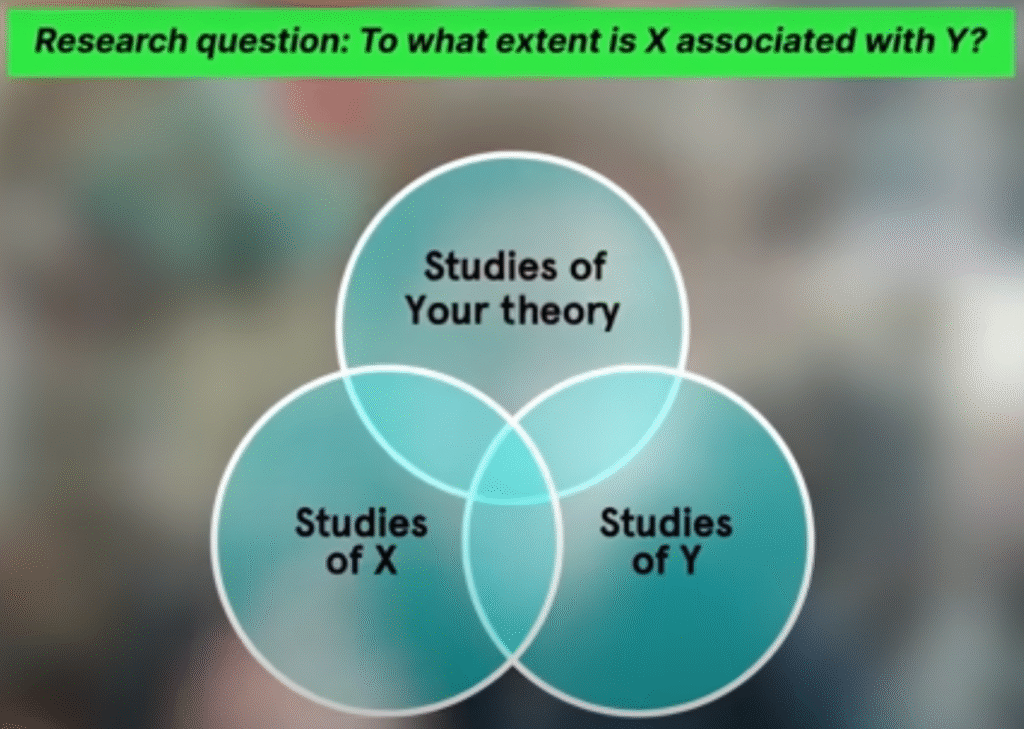
The power of the Venn diagram dissertation literature review approach lies in choosing the right three circles that represent the key dimensions of your study. These three circles should capture the most important aspects of your research design that, when combined, make your study unique.
The most common and effective combination is your independent variable (X), your dependent variable (Y), and either your theoretical framework or your population/sample. This combination works well because it covers the fundamental elements that define your research question and approach.
Let’s continue with our transformational leadership and employee engagement example. Your three circles might be:
Circle 1: Transformational Leadership (X) – This circle contains all studies that examine transformational leadership behaviors, regardless of what outcomes they measure or what populations they study.
Circle 2: Employee Engagement (Y) – This circle contains all studies that measure employee engagement, regardless of what factors they examine as influences on engagement or what populations they study.
Circle 3: Healthcare Organizations – This circle contains all studies conducted in healthcare settings, regardless of what leadership styles or employee outcomes they examine.
When you draw these three overlapping circles, you can see how different combinations create different types of studies. The overlap between circles 1 and 2 represents studies that examine transformational leadership and employee engagement – but not necessarily in healthcare settings. The overlap between circles 1 and 3 represents studies of transformational leadership in healthcare – but not necessarily focused on employee engagement. The overlap between circles 2 and 3 represents studies of employee engagement in healthcare – but not necessarily examining transformational leadership.
Your study sits at the center where all three circles intersect – studies of transformational leadership and employee engagement specifically in healthcare organizations. This visual representation immediately shows committee members that while components of your study have been researched before, no previous study has examined this specific combination.
You could also choose theoretical framework as your third circle instead of population. For example, if your study is the first to apply self-determination theory to understanding the relationship between transformational leadership and employee engagement, your three circles might be transformational leadership, employee engagement, and self-determination theory.
The key is choosing three dimensions that accurately represent what makes your study unique and that, when combined, create a space that no existing study occupies.
Where Your Study Sits
The power of the Venn diagram becomes clear when you show exactly where your study is positioned – at the intersection of all three circles. This intersection represents the unique combination of elements that no previous study has examined.
Your study doesn’t exist in isolation from existing research. It builds on studies in each of the individual circles and studies in the two-circle overlaps. But the three-circle intersection is where your original contribution lies.
Using our healthcare example, you can explain to your committee: “While there are studies of transformational leadership (circle 1), studies of employee engagement (circle 2), and studies conducted in healthcare organizations (circle 3), no existing research sits at the intersection of all three circles. My study will be the first to examine how transformational leadership specifically affects employee engagement in healthcare settings.”
This positioning shows that your study is both grounded in existing literature and genuinely original. You’re not conducting research in a vacuum – you’re building on established knowledge about transformational leadership, employee engagement, and healthcare organizations. But you’re combining these elements in a way that hasn’t been done before.
The visual representation also helps you explain your study’s significance. Because your research sits at the intersection of all three circles, it will contribute to understanding in multiple areas. Your findings will inform transformational leadership research, employee engagement research, and healthcare management research.
This positioning also helps justify your methodology and theoretical framework. If you’re using theories from the transformational leadership literature to explain relationships you’re studying in healthcare settings, the diagram shows why that theoretical application makes sense. You’re not randomly borrowing theories from unrelated areas – you’re applying relevant theories to a new context.
The center intersection also represents where your study will make its most significant contribution. While your research will add to knowledge in each individual circle and each two-circle overlap, the unique insights will come from understanding how all three elements work together in ways that haven’t been studied before.
Other Overlaps
One of the most powerful aspects of the Venn diagram approach is showing committee members how your study relates to existing research while demonstrating its uniqueness. By discussing the two-circle overlaps, you show that you understand the existing literature thoroughly while making clear why your three-circle intersection is original.
The overlap between circles 1 and 2 (transformational leadership and employee engagement) represents existing studies that examine this relationship but not necessarily in healthcare settings. You would acknowledge these studies and explain how they inform your research while noting that they were conducted in different contexts.
“Several studies have examined the relationship between transformational leadership and employee engagement in manufacturing and business settings (Smith, 2019; Jones, 2020; Brown, 2021). These studies consistently find positive relationships between transformational leadership behaviors and employee engagement levels. My study builds on these findings by examining whether this relationship holds in healthcare organizations, which have unique characteristics that might influence how leadership affects engagement.”
The overlap between circles 1 and 3 (transformational leadership and healthcare) represents studies that examine transformational leadership in healthcare settings but focus on different outcomes. You might find studies that examine how transformational leadership affects patient safety, job satisfaction, or turnover in healthcare – but not employee engagement specifically.
“Research has examined transformational leadership in healthcare settings, focusing primarily on outcomes like job satisfaction (Wilson, 2018) and patient safety behaviors (Davis, 2020). While these studies demonstrate that transformational leadership is relevant in healthcare contexts, none have specifically examined its relationship to employee engagement, which is a distinct construct with different implications for organizational performance.”
The overlap between circles 2 and 3 (employee engagement and healthcare) represents studies that examine employee engagement in healthcare settings but don’t focus on transformational leadership as an antecedent. These might be studies that examine how job characteristics, organizational culture, or individual factors influence engagement among healthcare workers.
“Several studies have examined factors that influence employee engagement among healthcare workers, including job autonomy (Miller, 2019) and organizational support (Taylor, 2021). However, none of these studies have specifically examined transformational leadership as a driver of engagement in healthcare settings.”
By acknowledging these two-circle overlaps, you demonstrate comprehensive knowledge of the related literature while clearly showing why your three-circle intersection represents a genuine gap. You’re not claiming that no one has ever studied any of these topics – you’re showing that no one has studied this specific combination.
Practical Tips
Implementing the Venn diagram dissertation literature review approach requires some practical considerations to make it most effective during your proposal defense and throughout your dissertation process.
First, keep your diagram simple and clean. Use three clearly labeled circles with enough overlap to show meaningful intersections. Avoid cluttering the diagram with too much text or too many details. The goal is immediate visual clarity, not comprehensive information display.
When creating your diagram for proposal slides, use a larger font size for the circle labels and make sure the intersection areas are clearly visible. Committee members should be able to read and understand your diagram from across a conference room. Consider using different colors for each circle to make the overlaps more visually distinct.
Practice explaining your diagram clearly and concisely. You should be able to walk through the three circles, the two-circle overlaps, and your study’s position at the center intersection in about two minutes. This explanation should feel natural and conversational, not like you’re reading from a script.
Prepare for questions about your circle choices. Committee members might ask why you chose your specific theoretical framework or population as the third circle instead of other possibilities. Have clear reasoning for your choices based on what makes your study most unique and significant.
Consider how your diagram connects to your research questions and methodology. Your Venn diagram should logically lead to your specific research questions and justify your methodological choices. If your study sits at the intersection of transformational leadership, employee engagement, and healthcare organizations, your research questions should clearly address that intersection.
Use your diagram strategically throughout your proposal defense. Reference it when explaining your literature review, when justifying your research questions, and when defending your methodology. The diagram provides a visual anchor that helps committee members follow your reasoning.
Be prepared to discuss limitations that your positioning might create. If your study is highly specific (sitting at a narrow three-circle intersection), committee members might ask about generalizability. Have thoughtful responses about how your specific focus contributes to broader understanding while acknowledging the boundaries of your findings.
Finally, consider creating a more detailed version for your written dissertation that includes specific citations in each circle and overlap area. This shows committee members exactly which studies you’re referencing when you describe existing research in each area.
Ready to Pull It All Together?
The Venn diagram approach provides powerful visual evidence of your study’s originality that committees can immediately understand and appreciate. When you can show exactly where your research sits in relation to existing studies, you eliminate questions about whether your work is truly unique and worth pursuing.
But the diagram is most effective when it represents the culmination of systematic literature review work. Your three circles should emerge naturally from your comprehensive understanding of the existing research, your clear identification of gaps in the literature, and your strategic positioning of your study to address those gaps.
The next step involves pulling together all the elements of your literature review – your systematic structure, your synthesis of existing research, your gap identification, and your visual representation of originality – into a compelling Chapter 2 that sets up your entire dissertation for success.
This final integration requires connecting your literature review to your research questions, theoretical framework, and methodology in ways that create seamless logical flow throughout your proposal. When done well, your literature review becomes the foundation that makes every other chapter feel inevitable and well-justified.
Ready to learn how to integrate all these literature review elements into a complete Chapter 2 that commands committee approval? The comprehensive approach concludes with techniques for creating literature reviews that serve as strong foundations for outstanding dissertations.
Contact us today to work with professors who can help you create visual representations of your study’s originality that committees find compelling, or learn more about our dissertation writing service where we help students build literature reviews that clearly demonstrate their research contributions.